Lately I've been making a spatial puzzle game
called “UNDERBUILD.”
You pick a block from a 3×3 grid
and keep adding it to the underside of a tower.
Like that certain wooden-stick balance game,
you'd normally stack things higher and higher,
but here you build new structures underneath
and lift up the tower that already exists.
How tall a tower can you build within the time limit? That's the rule.
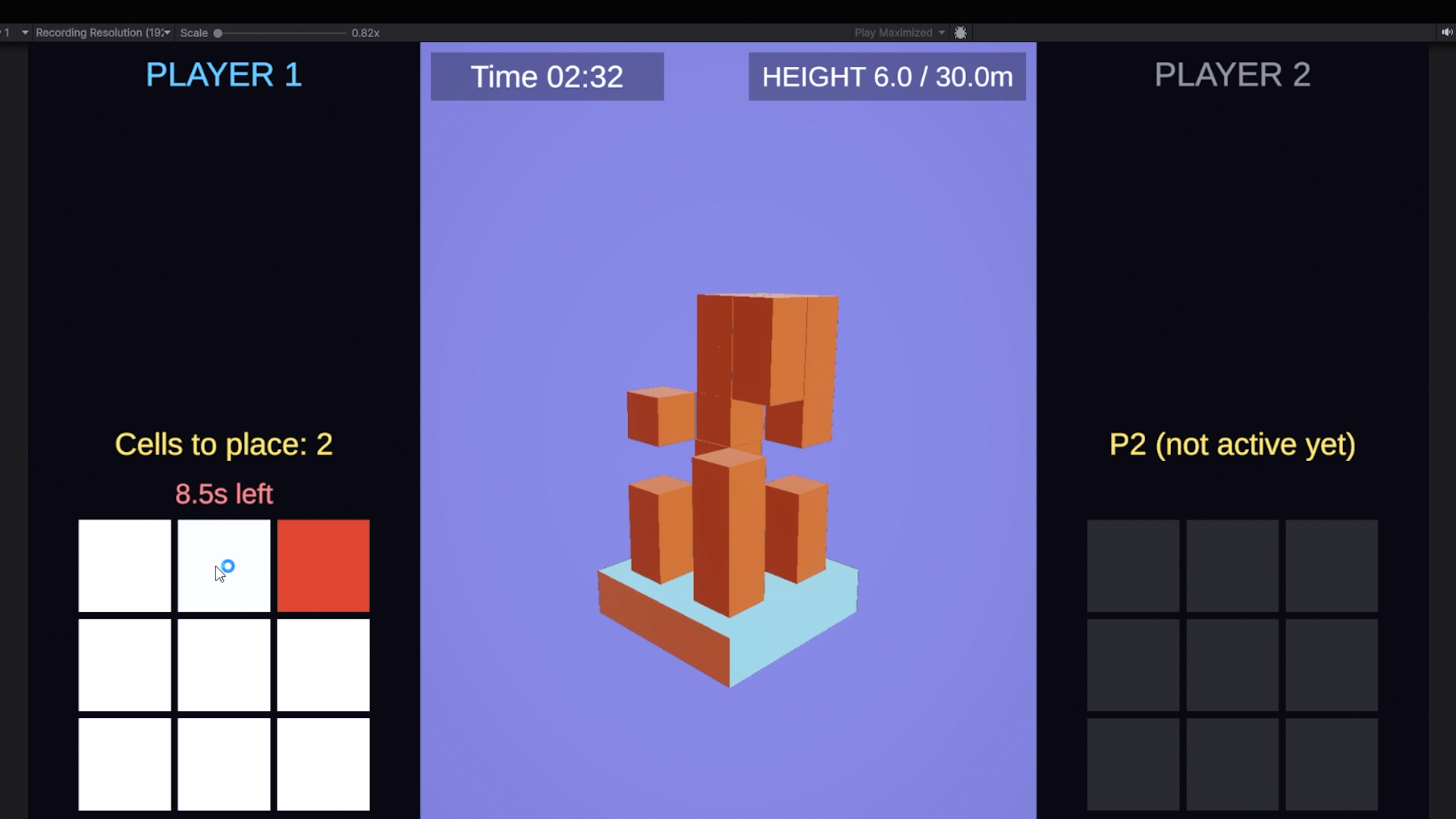
The system of this game has to implement
“something that could never happen in the real world”
no matter what.
In the real world,
if there's a hollow underneath, the object above falls down.
Gravity exists, so that's a perfectly ordinary physical phenomenon.
In this game, though, I can't have things falling.
In the game I'm making this time,
I have to generate new blocks from below
and make the tower taller and taller.
If there's a hollow underneath, you'd think it wouldn't matter
if the blocks above fell into it, right? But then
you'd just end up with a pointy mountain,
and there'd be fewer chances to lose your balance.
So blocks above a hollow must not fall.
In other words, they have to ignore gravity and keep their shape as a single 3×3 layer.
Implementing this rule itself was quick,
but right after solving it, the next problem showed up.
When the balance of the whole tower breaks,
I want it to collapse properly, according to the laws of physics.
The tilted tower sways, can't hold itself up any longer,
and the blocks that had been fixed together as 3×3 groups
fall apart as they crumble.
Until then they ignored gravity,
but at the moment of collapse, I want them to go back to real-world physics.
In other words, a moment when physics must be ignored
and a moment when physics must be obeyed coexist.
Pretty selfish, isn't it?
At first, I felt that if I just controlled the physics simulation correctly,
the game would work correctly too.
But if I apply real-world physics as is,
the rules of the game I'm making don't hold up at all.
And if I turn off all physics because of that,
the tower never falls over,
and it just becomes a matter of making it taller.
Taking rules that are plainly contradictory in reality
and making them hold up as perfectly normal rules inside the game.
Figuring that out was incredibly fun.
Using a physics simulation to ignore the laws of physics.
It's a thoroughly contradictory thing to do,
but making games is like solving puzzles, and that's what makes it fun.
I've also prepared a video so you can see how it actually moves.