I previously wrote an article called “A Game Where You Have to Justify Contradictions and Absurdity.”
A game where you have to justify contradictions and absurdities
The game I'm currently making, “UNDERBUILD,” has one big contradiction
that the game system simply can't avoid.
In this game, you keep placing new blocks underneath,
lifting the tower higher and higher.
Physically speaking, if there's an object below,
blocks stack on top of it as support.
But in UNDERBUILD,
the whole 3×3 block layout is treated as a single structure.
So even if there's no block directly underneath,
blocks must not fall into the empty spaces.
If everything fell according to real-world physics,
you'd end up with nothing but a plain heap in the end.
That would take away the tension of a balance game.
Still, for the player,
there's a lingering “why is this floating?” feeling.
So this time I made the contradiction “visible” to make it look at least a little more natural.
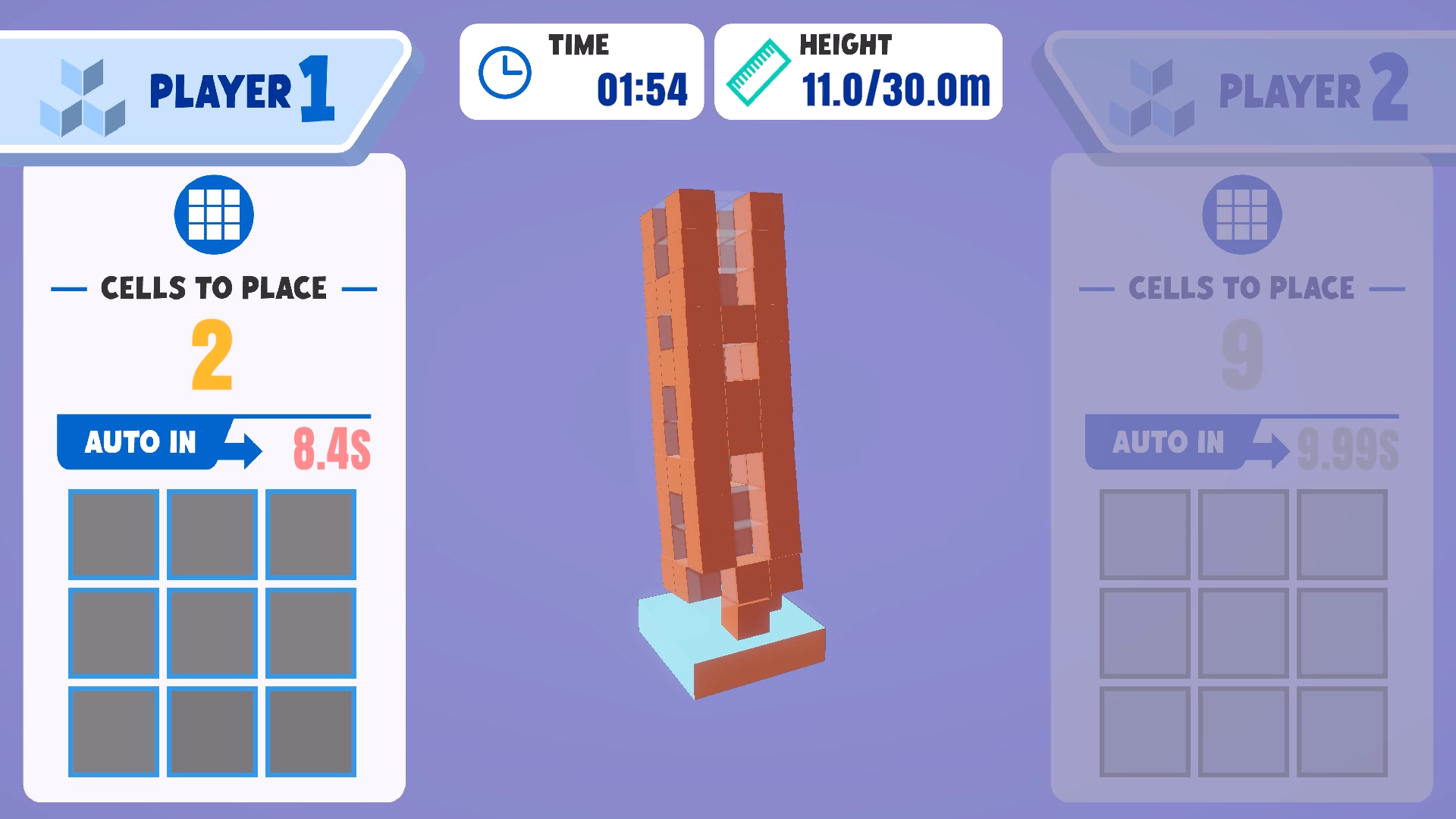
Deliberately Showing the Transparent Blocks
Internally, there's an auxiliary mechanism that supports the tower.
However, these auxiliary blocks don't have collision like regular blocks.
They exist purely within the game system, to bridge the moments when the tower would look like it's hanging in midair.
This time, by showing them as a faint, translucent structure,
it no longer looks like “a tower floating in empty space,”
but like it's “held up by some kind of in-game force.”
Present the contradiction as a rule of the game world.
Just that changed the impression quite a lot.
In a game, what matters more than matching reality
may be “something the player can accept.”
I Also Rebuilt the UI Substantially
Not just the game system: I changed the UI quite a bit, too.
Since it was in development, the old screen
was basically the necessary numbers and buttons placed wherever they fit.
- Current player
- Time remaining
- Current height / target height
- Number of cells you can place
- Time until auto-placement
- 3×3 placement area
I've organized all of these so you can grasp them at a glance as much as possible.
The PLAYER 1 and PLAYER 2 control areas sit on the left and right of the screen, with the actual structure in the center.
At the top are TIME and HEIGHT, which relate to the game as a whole.
I separated positions by the role of each piece of information like this.
I think “what should I be doing right now?”
is much clearer than before.
Once again I'm feeling that in game UI,
organizing the priority of information matters more than decoration.
Solo Play: 3 Stages Plus Endless
The game modes are gradually taking shape, too.
For solo play, I'll first prepare a mode where you aim for three levels of height.
You start with a low tower and gradually take on taller structures.
The other is Endless Mode.
There's no clear goal here;
you take on the challenge of “how high can you stack?”
Because of how the game system works, the higher you go,
the more even a slight imbalance in placement leads to big instability,
so I think it'll be a really fun mode.
I don't even know yet how high I can get myself.
Multiplayer Is About “Cooperation,” Not “Whoever Topples It Loses”
I also plan to implement a multiplayer mode.
With games that use building blocks or wooden sticks,
the first thing that comes to mind is a versus format where “whoever knocks it over loses.”
I considered a versus format for UNDERBUILD at first, too.
But I decided not to do that in this game.
The goal of multiplayer is “two players working together to lift the tower to the top.”
PLAYER 1 and PLAYER 2 place blocks, taking turns
or each with their own role,
building a single tower together.
Just like solo play, I plan to include a mode where you clear three target heights,
and a cooperative Endless Mode.
Instead of getting in each other's way,
- “Next, we should support this side.”
- “It might be risky to put it here.”
It would be fun if it became a game you play while talking like this.
Even with the same rules, I think playing alone and playing as a pair
feel quite different.
It's Gradually Becoming a “Game”
When you make a game,
it changes shape bit by bit:
an idea only, then barely working,
then a placeholder UI, then effects added.
It started with the idea of
“a reverse-style stacking game where you add blocks below the tower.”
From there,
“why doesn't the tower fall?” became a contradiction,
I thought about how to show it,
organized the UI, and worked out the game modes, and finally,
it's slowly starting to look like a game in its own right.
There's still a lot to adjust.
But the three solo stages, Endless Mode,
and cooperative multiplayer.
I'm getting really excited about getting it to a playable state.
What kind of game will a game born from a contradiction become?
I'll keep building it a bit more and find out.
I've also prepared a video so you can see how it actually moves.