I found out today that there's an instrument called the “Sanrele.”
It combines the Okinawan sanshin with a ukulele,
and as I watched I thought,
“It's fun, combining two instruments to make a new one.”
From there, for some reason, my brain took off in a completely different direction.
Could I make a cheap electronic instrument that kids can pick up and play more casually?
That's where all this started.
Stripping Things Off an Electronic Instrument
Building an electronic instrument takes a lot of parts.
A case, keys, switches,
a display, batteries...
But do we really need all of it from the start?
Take the keys, for example.
They don't have to sink down like piano keys.
As long as the instrument can tell it's being touched, it can make a sound.
So why not just make metal patterns shaped like keys right on the circuit board?
- No velocity needed.
- No LCD needed.
- No battery needed.
- No case needed.
I kept stripping things away,
and ended up at the thought:
“Why not just make the circuit board itself the instrument?”
Playing by Touching the Board Directly
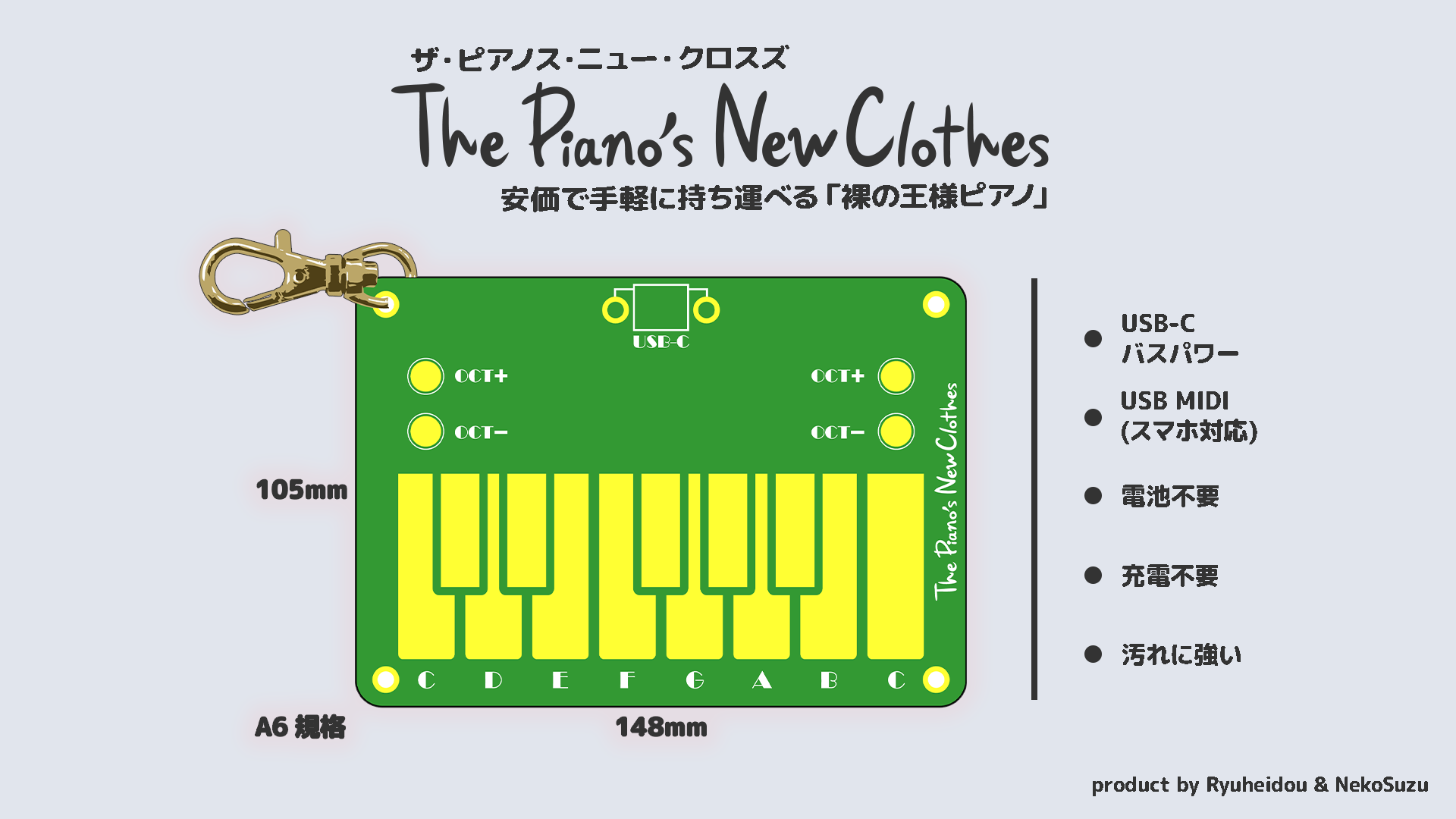
What I have in mind is a small board, about A6 in size.
On its surface I'll lay out one octave of keys: C, D, E, F, G, A, B, C.
The keys don't move, though.
The yellow-looking areas are themselves gold-plated touch electrodes.
You touch them with a finger, a capacitive sensor detects it,
and a sound plays. That's the whole thing. Very simple.
The octave setting won't be a button either;
it'll be the same kind of gold-plated touch electrode.
I want to get rid of physically moving parts as much as possible
and make an instrument you play by touching what's printed on the board.
Getting Rid of the Battery Too
Another thing I wanted to eliminate was the battery.
When I think about an electronic instrument for kids,
I really dislike that it becomes unplayable
just because “the batteries are dead”
or “it isn't charged.”
So it gets its power over USB-C.
Plug it into a USB power source and it's a small electronic instrument.
Plug it into a computer or smartphone and it's a MIDI input device.
With no built-in battery,
there's no need to worry about a rechargeable battery wearing out.
And when it's connected to a computer or smartphone,
I want it to work right away as a USB MIDI keyboard.
On its own, it's a small electronic instrument.
Connected to a computer, it's an input device for DTM (desktop music production).
It'll do both.
It Shrank Down to A6
At first I was thinking A5.
But as I worked on the design,
I started wondering, “Could I make it even smaller?”
and the current design is A6, at 148mm × 105mm.
And for some reason I even added a snap hook at the top left.
That means you can clip the instrument to your bag and carry it around.
I don't know whether anyone needs that.
But I like this kind of thing.
I'm not trying to build a high-end electronic instrument.
It's small, cheap, you plug in USB, and it makes sound when you touch it.
You can pull a mysterious circuit board off your bag and play it on the spot.
I think an electronic instrument like that would be fun to have.
Its Name Is “The Piano's New Clothes”
While thinking of a name, I came up with
“The Piano's New Clothes.”
It's a play on Andersen's “The Emperor's New Clothes” (called “The Naked King” in Japanese).
I stripped the case off an electronic piano,
then the physical keys, then the battery,
and kept taking things off
until only the circuit board was left.
And yet the name is “The Piano's New Clothes.”
I'm pretty happy with it.
I Haven't Built It Yet
This part is important, so I'll spell it out.
Right now it's purely in the planning and design stage.
The product images aren't photos of a real unit;
they're mockups made from the product design I drew up.
In particular, how stable can capacitive keys be at this size?
What happens when several keys are touched at once?
How do I combine USB MIDI with a standalone sound source?
Where do I put a tiny speaker?
And once a board is actually manufactured, is it easy to play?
There's still plenty to verify.
So I plan to consult people who know electronics well
and start by building Prototype 01.
Less Building an Instrument, More Building a Doorway
What I'm thinking of here won't replace a real piano.
- It doesn't have 88 keys.
- It has no velocity.
- It has no pedals.
- It doesn't contain a fantastic piano sound source either.
It's full of things it doesn't have. But I think that's fine.
You touch it and it makes a sound.
You plug the USB into a computer and the DAW responds.
“How does it know I touched this gold part?”
“Where do the lines on this board go?”
Starting from there, someone might get interested in music.
They might get interested in DTM.
They might get interested in electronics.
They might get interested in programming.
So this isn't so much a shrunken piano
as a small instrument that opens a doorway to all kinds of “making.”
It'd be great if I could turn it into something like that.
First, I'll build it until it actually makes sound.
The Piano's New Clothes.
If you strip a piano bare, what's left?
Probably a circuit board.